
Marketplace Optimization for Fashion Brands: Amazon vs Etsy vs eBay – Complete Strategy Guide
Fashion brands selling across Amazon, Etsy, and eBay need platform-specific optimization strategies. This complete guide compares marketplace algorithms, keyword tactics, image requirements, and pricing strategies—revealing exactly how to maximize visibility and conversions on each platform. Learn how Milano AI automates marketplace optimization with platform-specific content generation.
Fashion brands selling across marketplaces face a critical challenge: Amazon, Etsy, and eBay each demand different optimization strategies. Get it wrong, and your listings disappear into algorithmic obscurity. Get it right, and you unlock millions of ready-to-buy customers. This complete guide compares marketplace optimization tactics across all three platforms, revealing exactly how to maximize visibility, conversions, and ROI for your fashion e-commerce business.
Platform Comparison: Amazon vs Etsy vs eBay for Fashion Brands
Each marketplace serves distinct audiences and rewards different content strategies. Understanding these differences is critical for fashion brands maximizing multi-channel revenue.
| Feature | Amazon | Etsy | eBay |
|---|---|---|---|
| Primary Audience | Mass market, price-conscious buyers seeking fast shipping | Niche buyers seeking handmade, vintage, unique fashion | Bargain hunters, collectors, auction enthusiasts |
| Algorithm Focus | A9: Sales velocity, conversion rate, reviews, Prime eligibility | Relevance to handmade/vintage, listing quality score, shop performance | Cassini: Title relevance, listing completeness, seller ratings |
| Best Fashion Categories | Activewear, basics, accessories, mass-appeal apparel | Custom jewelry, handmade clothing, personalized accessories | Vintage fashion, overstock, limited editions, bundles |
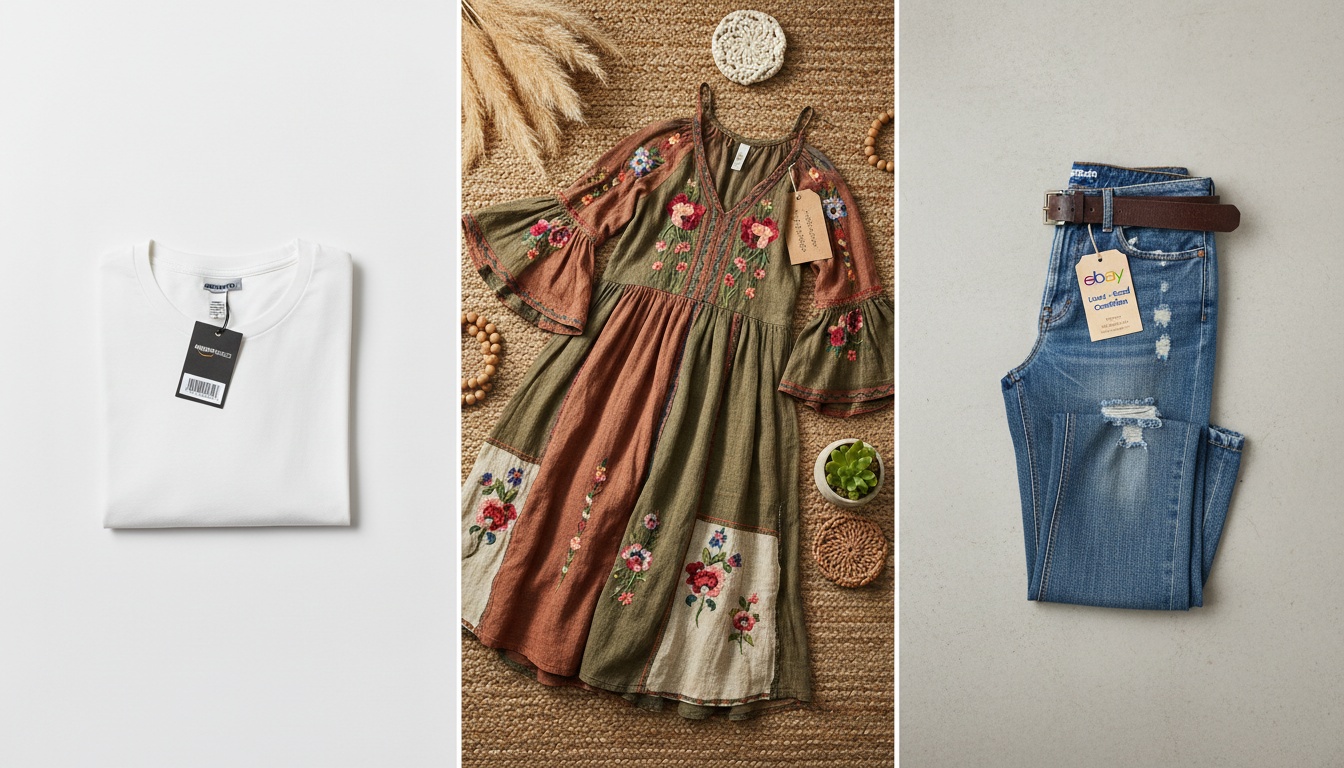
| Image Requirements | White background main image mandatory, 1000px minimum | Creative backgrounds allowed, lifestyle-heavy | Flexible, infographics perform well |
| Title Character Limit | 200 characters | 140 characters | 80 characters |
Strategic takeaway: Amazon rewards professional, standardized content optimized for conversion. Etsy rewards storytelling and uniqueness. eBay rewards completeness and competitive pricing. Fashion brands should tailor content strategy per platform rather than using identical listings across all three.
Keyword Strategy: Platform-Specific Optimization Tactics
Keywords drive marketplace visibility, but each platform's search algorithm prioritizes different factors.
Amazon Keyword Strategy
Amazon's A9 algorithm prioritizes sales velocity and conversion rate over pure keyword matching. Your optimization strategy:
- Front-load primary keywords in titles: "Women's Leather Crossbody Bag Black Small Vegan Purse"
- Use backend search terms (250 bytes) for secondary keywords without stuffing visible content
- Focus on long-tail commercial intent: "waterproof running jacket women plus size" converts better than "jacket"
- Leverage Amazon's autocomplete to identify high-volume search terms buyers actually use
- Monitor Brand Analytics (if Brand Registered) to track which keywords drive sales, not just impressions
Etsy Keyword Strategy
Etsy's algorithm rewards relevance to handmade/vintage categories and listing quality scores. Your approach:
- Emphasize uniqueness and customization: "custom embroidered denim jacket personalized gift"
- Use all 13 tags with specific, niche terms rather than broad categories
- Include materials and techniques: "hand-dyed silk scarf eco-friendly organic"
- Target gift-giving intent: "bridesmaid jewelry set personalized wedding"
- Use Marmalead or eRank to identify low-competition, high-intent keywords
eBay Keyword Strategy
eBay's Cassini algorithm prioritizes title relevance and listing completeness. Optimize with:
- Pack titles with specific details: "NWT Zara Floral Midi Dress Size M Summer Wedding"
- Include brand, condition, size, color in 80 characters—every word counts
- Use item specifics extensively—Cassini rewards complete attribute data
- Leverage Terapeak to identify trending keywords and optimal pricing
- Test auction vs Buy It Now formats for different keyword strategies
Cross-platform keyword insight: Fashion brands should maintain separate keyword research for each marketplace. Amazon buyers search "women's yoga pants high waist," Etsy buyers search "handmade organic cotton leggings," and eBay buyers search "Lululemon leggings size 6 NWT." Tailor accordingly.
Visual Content Optimization: Images That Convert by Platform
Fashion is inherently visual—your images determine 80% of conversion success. Each marketplace demands different visual strategies.
Amazon Image Requirements
- Main image: Pure white background (RGB 255,255,255), product fills 85% of frame, no text/logos
- Secondary images (6-9 total): Lifestyle shots with models, detail closeups, size charts, infographics
- Minimum 1000px on longest side to enable zoom (1500px+ recommended)
- Ghost mannequin effect for apparel—shows garment shape without distracting model
- A+ Content (if Brand Registered): Enhanced lifestyle imagery, comparison charts, brand storytelling
Etsy Image Strategy
- Creative backgrounds encouraged—show personality and brand aesthetic
- Lifestyle-heavy approach—show products being worn/used in authentic contexts
- First image is critical—this appears in search results and determines click-through rate
- Show scale and detail—include hand/body references for jewelry and accessories
- Diverse model representation—Etsy buyers value inclusivity and authenticity
eBay Image Optimization
- Flexible formats—white backgrounds work but aren't mandatory
- Infographics perform well—fabric composition, sizing charts, care instructions
- Show condition clearly—especially critical for vintage and pre-owned fashion
- Bundle shots—if selling lots, show all items together and individually
- Mobile-first approach—70%+ of eBay traffic is mobile, ensure images are clear on small screens

Pricing Strategy: Platform-Specific Competitive Tactics
Pricing psychology differs dramatically across marketplaces. Fashion brands must adapt strategies per platform.
| Strategy | Amazon | Etsy | eBay |
|---|---|---|---|
| Pricing Model | Competitive pricing with .99 endings, dynamic repricing tools | Premium pricing for handmade (10-20% above mass market) | Auction starts low, Buy It Now at competitive rates |
| Fee Structure Impact | 15-30% referral fees—build into pricing | 6.5% transaction fee + $0.20 listing—lower overhead allows premium pricing | 12.9% final value fee—factor into margins |
| Shipping Strategy | Free shipping expected (Prime standard), build into price | Calculated shipping acceptable, free shipping boosts search ranking | Calculated shipping common, offer combined shipping for multiple items |
| Promotional Tactics | Lightning Deals, Coupons, Subscribe & Save discounts | Sales badges (15%+ off), free shipping thresholds | Promoted Listings, Best Offer option, volume discounts |
Pricing intelligence: Use repricing tools (RepricerExpress for Amazon, Price Spectre for eBay) to stay competitive. For Etsy, emphasize value over price—buyers pay premium for uniqueness and customization.
How Milano AI Transforms Marketplace Optimization for Fashion Brands
Managing optimized content across Amazon, Etsy, and eBay traditionally requires separate photoshoots, copywriters, and endless manual updates. Milano AI eliminates this complexity entirely.
Platform-specific visual content at scale: Upload your product photos once, then generate unlimited variations optimized for each marketplace. Create Amazon-compliant white background images, Etsy-style lifestyle scenes with authentic settings, and eBay infographics—all from a single dashboard. Our AI understands each platform's requirements and automatically formats images accordingly.
Bulk optimization for entire catalogs: Fashion brands with 100+ SKUs can't afford individual photoshoots per product. Milano AI's bulk upload processes entire catalogs simultaneously, generating marketplace-optimized images for every SKU in minutes. Ghost mannequin effects for Amazon apparel, lifestyle contexts for Etsy jewelry, bundle shots for eBay lots—all automated.
SEO-optimized descriptions per platform: Our AI generates keyword-rich product descriptions tailored to each marketplace's algorithm. Amazon descriptions emphasize features and benefits with backend keyword optimization. Etsy descriptions tell brand stories with handmade authenticity. eBay descriptions focus on condition, specifications, and completeness.
Video content for competitive advantage: Amazon A+ Content now supports video. Etsy listings with video get 2x engagement. eBay video listings convert 30% higher. Milano AI creates professional product videos, AI avatar demonstrations, and campaign content—giving fashion brands the visual edge competitors lack.
Complete marketplace management suite: Beyond content creation, Milano AI provides competitor intelligence tracking pricing and keywords across all platforms, automated social media posting to drive external traffic to listings, SEO-optimized blog content that ranks on Google and drives marketplace traffic, and analytics dashboards comparing performance across Amazon, Etsy, and eBay.
ROI for multi-channel fashion brands: Traditional marketplace optimization requires hiring photographers ($2,000-5,000 per shoot), copywriters ($50-150 per listing), and agencies ($3,000-10,000/month for management). Milano AI delivers the same professional quality for $199-499/month unlimited—a 95% cost reduction while scaling production 10x faster.
Fashion brands using Milano AI report 40-60% increases in marketplace conversion rates, 3-5x faster time-to-market for new products, and 70-80% reduction in content production costs. Whether you're an indie label launching on Etsy or an established brand scaling across all three marketplaces, Milano AI is your complete optimization platform.
Ready to dominate Amazon, Etsy, and eBay with optimized content? Start with Milano AI's free trial—10 credits to test platform-specific image generation, no credit card required. See how professional marketplace optimization transforms your fashion e-commerce performance.
Frequently Asked Questions
The best marketplace depends on your fashion brand's positioning. Amazon excels for mass-market apparel, activewear, and accessories with broad appeal—ideal for brands prioritizing volume and fast shipping. Etsy dominates for handmade, custom, vintage, and unique fashion items where buyers pay premium for authenticity and personalization. eBay works best for overstock, vintage fashion, limited editions, and auction-style selling. Most successful fashion brands use a multi-channel strategy, optimizing content specifically for each platform's audience and algorithm rather than choosing just one.
Scale Your Fashion E-Commerce with AI
Create professional campaigns and product photography in minutes. Start with 10 free credits—no credit card required.
Related Articles

Professional Product Videos with AI: The Ultimate Q&A Guide for Fashion Brands
Learn how fashion e-commerce brands can create professional product videos with AI, replacing expensive photoshoots with automated video generation. This Q&A guide covers AI avatars, conversion optimization, and scaling video content across your entire catalog—cutting costs by 95% while accelerating production from weeks to minutes.

AI Lifestyle Videos: Compare Top Tools for Fashion Brands in 2026 | Milano AI Guide
Compare top AI lifestyle video tools for fashion e-commerce in 2026. Detailed analysis of Synthesia vs HeyGen vs Runway ML vs Pika Labs vs Milano AI. Learn which platforms deliver ROI for DTC brands, with actionable implementation strategies and cost comparisons. Cut video production costs by 95% while scaling output 10x.

Marketplace Video Optimization: How Fashion Brands Scale Conversions 30%+ in 2026
Fashion brands see 30%+ conversion lifts with optimized marketplace videos, but manual production fails at scale. Learn the cause-and-effect strategies driving success on Amazon, Etsy, and Shopify in 2026—from AI compression eliminating load penalties to shoppable overlays converting views into sales. Complete guide with actionable tactics for DTC brands and retailers.